
How Paterna Biosciences Is Shaping the Future of Reproductive Medicine
The Fertility Crisis We Can’t Ignore
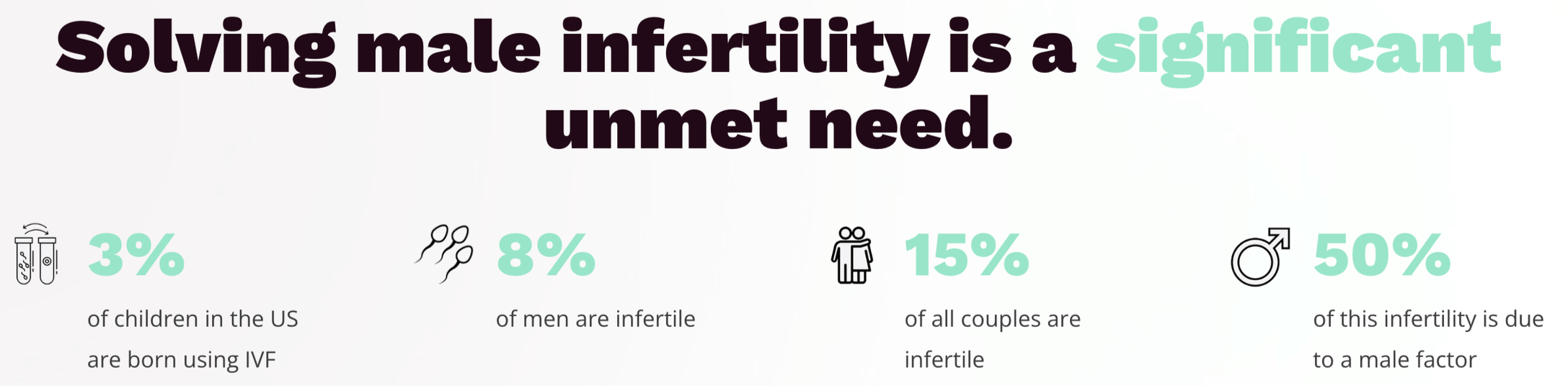
Infertility affects one in six couples worldwide, and in half of those cases, the issue lies with the male partner. Yet despite the scale of the problem, male infertility care has not improved since the 1970s. The last major breakthrough was in vitro fertilization (IVF), now accounting for more than 500,000 births annually.
In the U.S. alone, the number of IVF cycles continues to climb—389,993 in 2022, rising 11% to 432,641 in 2023.
Today, there are still no effective FDA-approved therapies for male infertility. The standard of care still relies on the same limited interventions—hormone treatments, surgery, or IVF—and these often fail.
“We have vast technology at our disposal in healthcare and scientific research today,” says Dr. Alex Pastuszak, co-founder and CEO of Paterna Biosciences. “When treating my patients, it’s so disheartening what my playbook is—only a couple of medications and maybe two surgeries that may or may not make a difference in helping my infertile male patients.”
Globally, about 3 million IVF cycles are performed each year, and nearly half of them fail. Male factors account for about 50 percent of those failures. It’s a profound loss for couples who often endure years of emotional and financial strain. For physicians like Pastuszak, who have to deliver the heartbreaking news that there’s nothing more they can do, this became the reason to pursue better treatment options for people longing for a path to parenthood.
For Pastuszak and his co-founders, Jim Hotaling, MD and Brad Cairns, PhD, delivering that same message again and again to patients for 15 years drove them to solve this rising global health problem.
The Paterna Solution: Teaching Cells to Become Functional Sperm

Alex Pastuszak, MD, PhD: Co-founder and Chief Executive Officer
Paterna Biosciences was born out of frustration and hope. The founders wanted to change what’s possible for men facing infertility by focusing on the biology that everyone else had ignored. Their work centers on in vitro spermatogenesis—the process of developing mature, functional sperm from spermatogonial stem cells entirely outside the human body.
“Our team has a lot of firsts with many more on the horizon,” Pastuszak says. “When our R&D is complete, we will have the ability to take the starting spermatogonial stem cell and turn them into a sperm completely in a dish.”
“This scientific approach could reshape how fertility care is delivered. Instead of relying on donor sperm or trying to find sperm in the testis, we will be able to take a small testicular tissue sample, grow new sperm cells in the lab, validate they are high quality, and use them for IVF, giving men with previously untreatable infertility a real chance to have biological children,” says Pastuszak.
The Bigger Picture: Changing the Conversation Around Fertility
For Pastuszak, this isn’t just a scientific breakthrough. It’s a chance to change how society views fertility itself.
“If we can change not just the way that fertility is treated, both for men and women, but if we can change the conversation around fertility and human reproduction—with this technology, then that’s a huge win for humanity,” Pastuszak says.
That shift matters. Fertility rates are falling globally, and some countries are already facing population decline. The conversation around infertility has long centered on women, leaving the male side of the equation under-researched, underfunded, and misunderstood. Paterna’s work challenges that imbalance. By focusing on male reproductive biology, the company is tackling a problem that affects millions globally but has been largely invisible in medicine.
Their research also has ripple effects beyond fertility. Understanding how sperm form, mature, and carry genetic information could uncover new insights into age-related disease, genetic stability, and even cancer. In that sense, Paterna isn’t just solving a reproductive issue—it’s expanding our understanding of human biology itself.
Momentum and Funding: Backed by Belief in a Breakthrough
In October 2024, Paterna Biosciences closed a $6.8 million seed round, led by SpringTide Ventures, with participation from the Utah Innovation Fund, e184 and others. The investment expanded the company’s research and development efforts, paving the path to preclinical and clinical development.
Ryan Morley, Partner at SpringTide Ventures, the lead investor in this round, commented: “Paterna Biosciences exemplifies the kind of innovative thinking and scientific rigor we prioritize. Their approach to addressing male infertility—an area that has seen little innovation in nearly 3 decades—has the promising potential to significantly impact fertility treatments, reducing costs and improving outcomes. We’re excited to support the Paterna team in their mission to help families achieve their dreams of parenthood.”
At the company’s new lab opening in Salt Lake City, Pastuszak was joined by his co-founders, Dr. Brad Cairns, Chief Scientific Advisor and a world-renowned expert in chromatin and sperm biology, and Dr. Jim Hotaling, Board Chairman and a male reproductive urologist. The team’s combined expertise spans decades of molecular biology, genetics, and clinical medicine.
Paterna’s goal isn’t just to produce sperm cells, but to improve the quality and reliability of IVF outcomes overall. “Currently, the selection of male gametes is very subjective and done by an embryologist sitting under a microscope looking at and choosing sperm without good selection criteria,” he said. “Where we have an advantage is that we are looking at the entire process, start to finish, and we can do an extensive array of testing on those gametes to exclude those with genetic and other defects that could impact everything from fertilization to live birth. Essentially, we will be pre-qualifying these cells before we ever deliver them to the IVF clinic.”
In June 2025, the company was also selected as one of 16 startups nationwide to join the Tampa Bay Wave HealthTech|X Accellorator, a nonprofit technology accelerator designed to support science-driven healthcare solutions and backed by the U.S. Economic Development Administration. Earlier in 2025, Paterna also participated in the Mayo Clinic and Arizona State University MedTech Accelerator, where the company earned the Disruption Award for its breakthrough approach to male infertility.
“Participating in programs like HealthTech|X and the Mayo/ASU MedTech Accelerator gives us access to top-tier mentors, funding networks, and national visibility,” says Pastuszak. “It’s another signal that what we’re building in male fertility isn’t just novel—it’s part of a broader movement to redefine how healthcare innovation can finally address overlooked but urgent human needs.”
Human Impact: Hope in the Lab
Behind every scientific milestone are real people who have been told no. Paterna’s mission is to turn 'no' into new hope. For men with genetic infertility, cancer survivors who lost reproductive function during treatment, this work offers a fertility future that didn’t exist before.
“We’re not just doing this for the science,” Pastuszak says. “We’re doing it for the people who sit in our offices and ask if there’s any chance left. We want to give them that chance.”
Because Paterna’s approach uses a patient’s own adult stem cells, it eliminates many of the ethical and medical complications associated with donor materials. The technology also opens the door to greater equity in fertility care, making biological parenthood possible for groups who’ve historically been left out of the conversation.
What Comes Next: Certainty Instead of a Coin Flip
The future Paterna Biosciences is working toward is both practical and profoundly human. The goal is not to give couples a percentage or a probability, but a real, proven, and medically supported possibility.
“I want to be able to look a couple in the eye—whether the problem is with the man, the woman, or both—and tell them there’s a huge chance that they will be successful,” Pastuszak says. “Rather than telling them this is a flip of a coin, I want to give them certainty.”
This is what Paterna is building: a future where infertility is not a life sentence, but a solvable medical condition, backed by science and compassion, and where every couple who dreams of having a family has more than hope. They have a path.
